

Table of Contents
- Microcurrent Facial vs Salon Treatment: The Key Differences
- Salon Treatment vs At-Home Device: A Side-by-Side Comparison
- EMS vs Microcurrent Facial: What's the Difference?
- How Often to Use a Microcurrent Facial Device
- Microcurrent Facial Safety and Contraindications
- Best At-Home Microcurrent Devices for a Consistent Routine
- Realistic Results: What to Expect and When
- Frequently Asked Questions
Last Updated: October 19, 2026
Microcurrent Facial vs Salon Treatment: The Key Differences
A microcurrent facial uses low-level electrical current to stimulate facial muscles and skin, while a salon treatment delivers the same technology in a clinic under a practitioner's hands.
The short answer: a salon course suits anyone who wants professional supervision and hands-on technique, while an at-home device suits anyone who wants frequency without the repeat spend. Consistency matters more than intensity in either case.
What a salon microcurrent facial involves
A salon microcurrent facial is a practitioner-led session using professional equipment and conductive gel, typically lasting between 30 and 60 minutes.
Sessions are usually sold as a course rather than a one-off, because results depend on repetition. Expect a consultation first, patch tests where relevant, and aftercare advice. The appeal is the hands-on skill: a trained therapist can adapt pressure and placement in real time.
The trade-off is logistics. Appointments, travel and repeat costs add up, and results fade if you stop attending.
What an at-home microcurrent facial involves
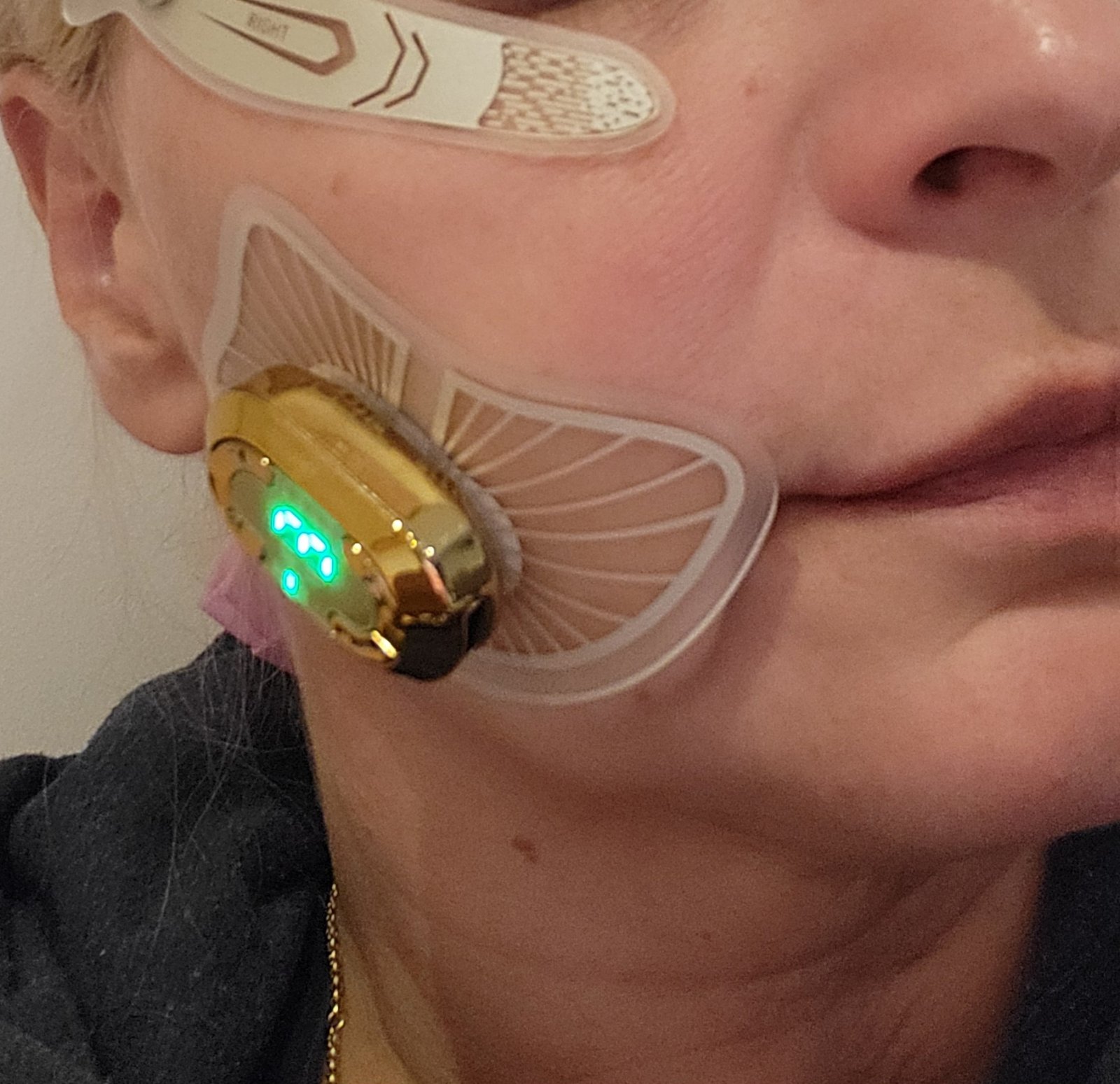
An at-home microcurrent facial is a self-administered session using a consumer device, usually for a fixed 15-minute window. Wearable formats, such as EMSTIGHT's patch and mask devices, run automatically and switch off when the session ends, so there is no timer to watch and no wand to glide.

The advantage is frequency. Because the device lives in your bathroom, you can build a routine around it rather than around appointment availability. The limitation is technique: nobody is adjusting the current for you, so you follow the instructions and choose your own intensity.
Salon Treatment vs At-Home Device: A Side-by-Side Comparison
Neither option wins outright. Salon treatment wins on supervision and hands-on technique; an at-home device wins on cost per session and convenience.
Factor |
Salon Treatment |
At-Home Device |
|---|---|---|
Who controls the session |
Trained practitioner |
You |
Session length |
30-60 minutes |
Typically 15 minutes |
Frequency |
Weekly or fortnightly course |
Several times a week |
Cost pattern |
Repeat fee per session |
One-off device cost |
Travel required |
Yes |
None |
Hands-free option |
No |
Yes, with wearable formats |
Technique support |
Real-time adjustment |
Fixed programme and intensity levels |
Best for |
Supervision, hands-on work |
Consistency, busy schedules |
Pros of salon treatment: professional assessment, adjusted technique, a relaxing appointment, and no equipment to store or charge.
Cons of salon treatment: ongoing cost, scheduling friction, and results that depend on attendance.
Cons of at-home use: you must learn correct placement, you manage your own intensity, and results still depend on showing up for yourself.
The cost question, honestly framed
Salon microcurrent facials are usually priced per session, and because results depend on repetition, the realistic comparison is not one appointment against one device. It is a course of sessions against a device you keep.
That does not make the device cheaper in every case. If you attend a salon only occasionally, or you value the hands-on adjustment and the appointment itself, the salon route can be better value for you.
What the salon actually adds
A trained practitioner can read your face in real time: adjusting intensity where skin is sensitive, changing placement around the jaw and brow, and combining the current with cleansing, exfoliation and a mask. That combination is part of the salon experience and is difficult to replicate at home. The trade-off is that you cannot attend often enough to match the frequency a home device allows, and results fade if you stop attending.
What the device actually adds
A wearable device removes the two barriers that most often break a routine: time and technique. EMSTIGHT's mask and patch formats run a fixed 15-minute session and switch off automatically, so there is no wand to hold and no timer to watch. The limitation is that nobody adjusts the current for you, so you follow the instructions and choose your own intensity. For a fair comparison of the two routes in practice, see our guide to how often to use a microcurrent facial device.
EMS vs Microcurrent Facial: What's the Difference?
In practice, many consumer devices blend the two, and marketing language often blurs them. EMSTIGHT's devices are described as EMS microcurrent beauty devices, which reflects that overlap rather than a clinical distinction.

What matters for a buyer is the sensation and the routine. Microcurrent-style sessions tend to feel like a faint tingle; EMS-style stimulation can produce a light pulsing sensation. Neither should be uncomfortable.
Both are cosmetic approaches. Neither is a medical treatment, and neither should be presented as one.
How Often to Use a Microcurrent Facial Device
Most at-home routines work best at three to five short sessions a week, built around a fixed 15-minute slot. Frequency beats duration: a consistent short session is more useful than an occasional long one.
A workable pattern looks like this:
- Weeks 1-4: three sessions a week, at a low intensity while you learn placement
- Weeks 5-8: increase to four or five sessions if your skin is comfortable
- Ongoing: maintain three sessions a week, or step up before an event
Salon courses usually run weekly for a set number of weeks, then taper to maintenance appointments. The logic is the same in both settings: build a base, then maintain it.
Microcurrent Facial Safety and Contraindications
Microcurrent facials are generally well tolerated, but they are not suitable for everyone. Safety comes down to reading the guidance properly and stopping at the first sign of discomfort.
Placement rules matter just as much.
For salon treatment, disclose medical history at consultation and ask about patch testing. A reputable practitioner will decline to treat where it is not appropriate.
Best At-Home Microcurrent Devices for a Consistent Routine
The best at-home device is the one that fits your hands, your time and your willingness to repeat it.
EMSTIGHT's range is built around that idea. The EMS Microcurrent Face Mask at £119.00 is the flagship: a rechargeable host unit that attaches magnetically to a conductive sheet mask for one automatic 15-minute session across the full face.
For targeted work, there are focused patch options. The EMS Microcurrent Eye Patches at £89.00 cover the eye area with two hosts and one remote, while the EMS Microcurrent Cheek Patches at £89.00 cover the mid and lower face, including the jawline. The EMS Microcurrent Forehead Patches at £89.00 handle the brow with a single wide patch.
If you want the whole upper face in one session, the combined Eye, Cheek and Forehead Patches at £129.00 run five patches from one remote, so every area is treated at once.

A fair caveat: these are cosmetic beauty devices, not medical devices. They are not equivalent to professional clinical treatment, and individual experiences vary.
Realistic Results: What to Expect and When
Realistic expectations start with what microcurrent can and cannot do. A microcurrent facial is a cosmetic treatment aimed at the look of tone and firmness. It does not remove wrinkles permanently, and it does not replace clinical procedures. Anyone promising guaranteed lifting or permanent wrinkle removal is overselling, and claims without evidence should be treated sceptically.
Separating established effects from marketing claims
The mechanism is well described: low-level current is intended to stimulate facial muscles and skin below the threshold of a visible contraction. What is less settled is how large and how lasting the visible change is for any given person.
That is not a reason to dismiss it. It is a reason to judge any device on whether you will use it consistently, and to treat dramatic before-and-after claims with caution.
A sensible timeline
What users commonly report is a temporary look of freshness after a session, with more noticeable change building over weeks of consistent use. That pattern fits the mechanism: repeated low-level stimulation, not a single dramatic event.
- First session: a short-lived look of freshness, most visible in the hours afterwards
- Weeks 2-4: early changes in how the skin looks and feels, if sessions are regular
- Weeks 6-12: the point at which most people judge whether the routine is working for them
- Maintenance: results typically depend on continued use, in the same way salon results depend on attending
How long results last, and how the schedules differ
A single session's effect is short-lived, which is why frequency matters more than intensity. Salon courses usually run weekly for a set number of weeks, then taper to maintenance appointments; the gap between appointments is where the visible effect tends to fade. An at-home device allows several short sessions a week, which supports consistency between any salon visits you keep. In both settings the logic is the same: build a base, then maintain it. If you stop, the look you built tends to fade rather than hold.
Judging whether it is working for you
A practical test is to pick one thing you are watching, such as how the jawline or brow looks in the same light at the same time of day, and check it at the start and again at the six-to-twelve-week mark. That is a fairer measure than comparing against heavily edited marketing images. Individual experiences vary, and a cosmetic device is not equivalent to professional clinical treatment.
Frequently Asked Questions
What is the difference between an at-home microcurrent device and a salon microcurrent facial?
A salon microcurrent facial is performed by a trained therapist using professional equipment, usually as a course of sessions booked weeks apart. An at-home device, such as the EMSTIGHT EMS Microcurrent Face Mask (£119), delivers a lower-intensity session you run yourself in 15 minutes. The salon offers hands-on expertise and a stronger current; home use offers frequency, privacy and a one-off cost. Many people combine the two, using a home device between occasional professional appointments to keep up consistency.
How often should you use an at-home microcurrent device?
Most at-home devices are designed for regular short sessions rather than occasional long ones. A practical starting point is three to five 15-minute sessions a week, at a low intensity you find comfortable, then adjusting once you know how your skin responds. Consistency matters more than duration: a device used little and rarely is unlikely to show much. Always follow the manufacturer's instructions for your specific device and stop if you feel discomfort or irritation.
Are salon microcurrent facials more effective than at-home devices?
They are different tools rather than one being strictly better. A salon treatment uses professional-grade equipment and a therapist's hands, and a course can produce a more noticeable short-term effect. An at-home device delivers a gentler current but can be used far more often, which suits the consistency microcurrent relies on. Neither offers permanent wrinkle removal, and results fade without maintenance. Choose based on budget, time and how regularly you will actually use it.
Is EMS the same as microcurrent for the face?
They overlap but are not identical. Microcurrent typically refers to very low-level electrical current used in facial toning and sculpting routines. EMS (electrical muscle stimulation) uses a current intended to cause visible muscle contractions. Many home devices, including EMSTIGHT patches and masks, are described as EMS microcurrent because they combine the two ideas. If a device's listing does not state its frequency or current type, ask the brand before buying rather than assuming.
Are at-home microcurrent devices safe to use?
For most healthy adults they are considered low-risk cosmetic devices when used as instructed. However, they are not suitable for everyone. Do not use one if you have a pacemaker, defibrillator or other implanted electronic device, and speak to your doctor first if you are pregnant or breastfeeding or have a heart condition, epilepsy, a skin infection or metal implants in the treatment area. Keep patches away from the eyes, eyelids, lips and front of the throat, and stop if skin becomes red or itchy.
Deciding between a salon course and an at-home device comes down to how often you will actually show up. If appointments and repeat fees are the sticking point, EMSTIGHT's wearable range offers a practical alternative: hands-free 15-minute sessions, targeted patches for the eye, cheek and forehead areas, and a rechargeable design built for regular use at home. Explore the EMS Eye Patches to start a routine you can keep.


